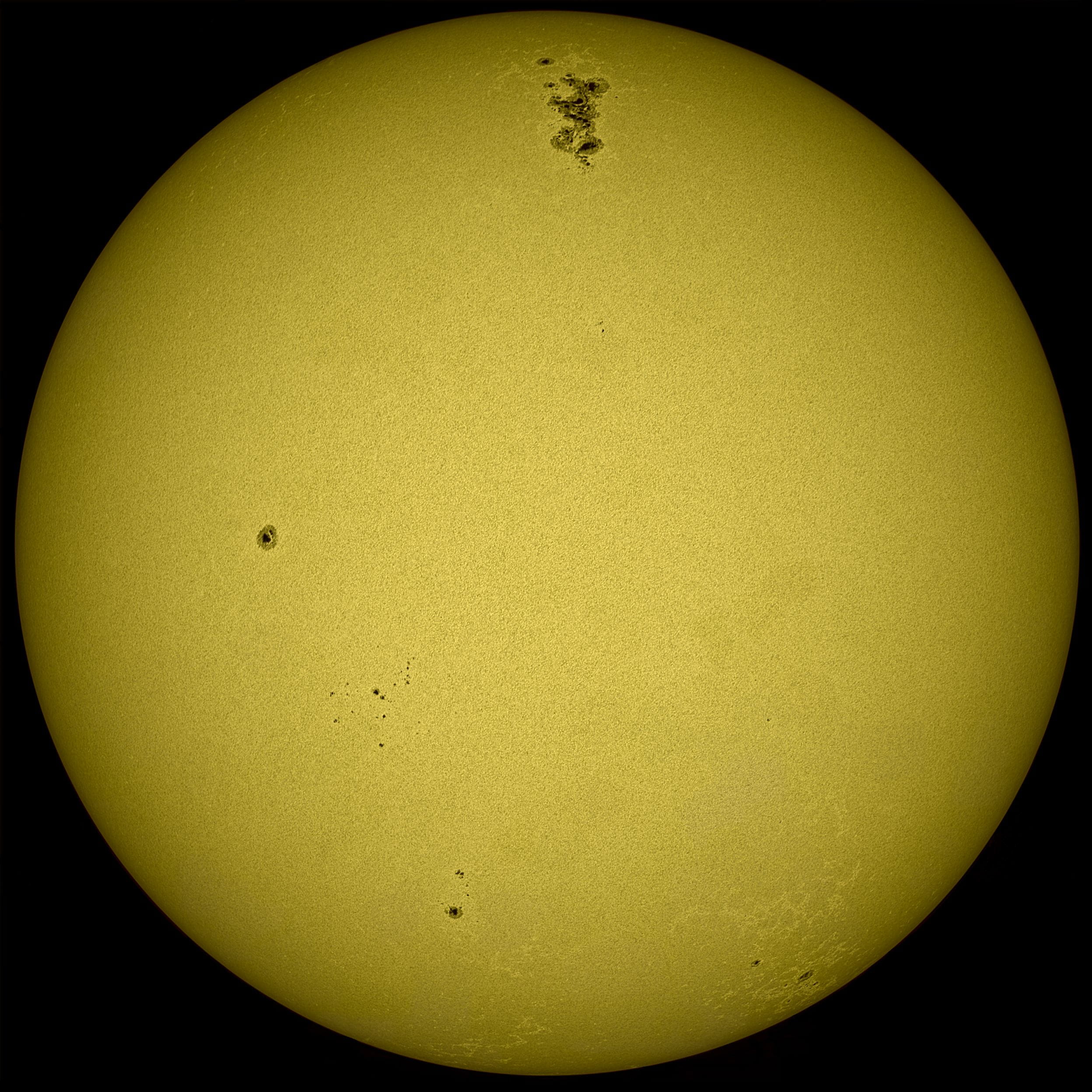
What Are Sunspots?
Sunspots are dark areas on the visible surface of the Sun. They may look like small marks, but some of them are larger than Earth.
They appear dark because they are cooler than the area around them. But “cooler” is relative: a sunspot can still be around 4,000 to 5,000 degrees Celsius. The surrounding solar surface is even hotter, at about 6,000 degrees Celsius.
How Do Sunspots Form?
Sunspots are caused by magnetic activity inside the Sun.
The Sun does not rotate like a solid ball. Its equator rotates faster than its polar regions. This stretches and twists the Sun’s magnetic field. In some places, the magnetic field becomes so strong and tangled that it slows down the movement of hot gas, or plasma, rising toward the surface.
Because less heat reaches that area, it becomes slightly cooler than its surroundings. That cooler region appears as a dark sunspot.
What Do Sunspots Mean for Us?
Sunspots come and go in a cycle of about 11 years. When there are many sunspots, the Sun is usually more active.
During active periods, the Sun can produce solar flares and coronal mass ejections. These are huge eruptions that send radiation and charged particles into space. Sometimes these particles reach Earth. When they interact with our planet’s magnetic field and atmosphere, they can create beautiful auroras, also known as the northern and southern lights.
In rare cases, strong solar storms can also affect satellites, radio communication, GPS systems, or power grids.
Can You See Sunspots Yourself?
Yes, but never look directly at the Sun with your eyes or through a telescope without proper protection. That can cause permanent eye damage.
With a certified solar filter on a telescope, or by using a safe solar projection method, sunspots can be observed safely. They often look like small dark spots — but once you know what is happening there, you realize you are looking at powerful magnetic storms on the surface of our star.