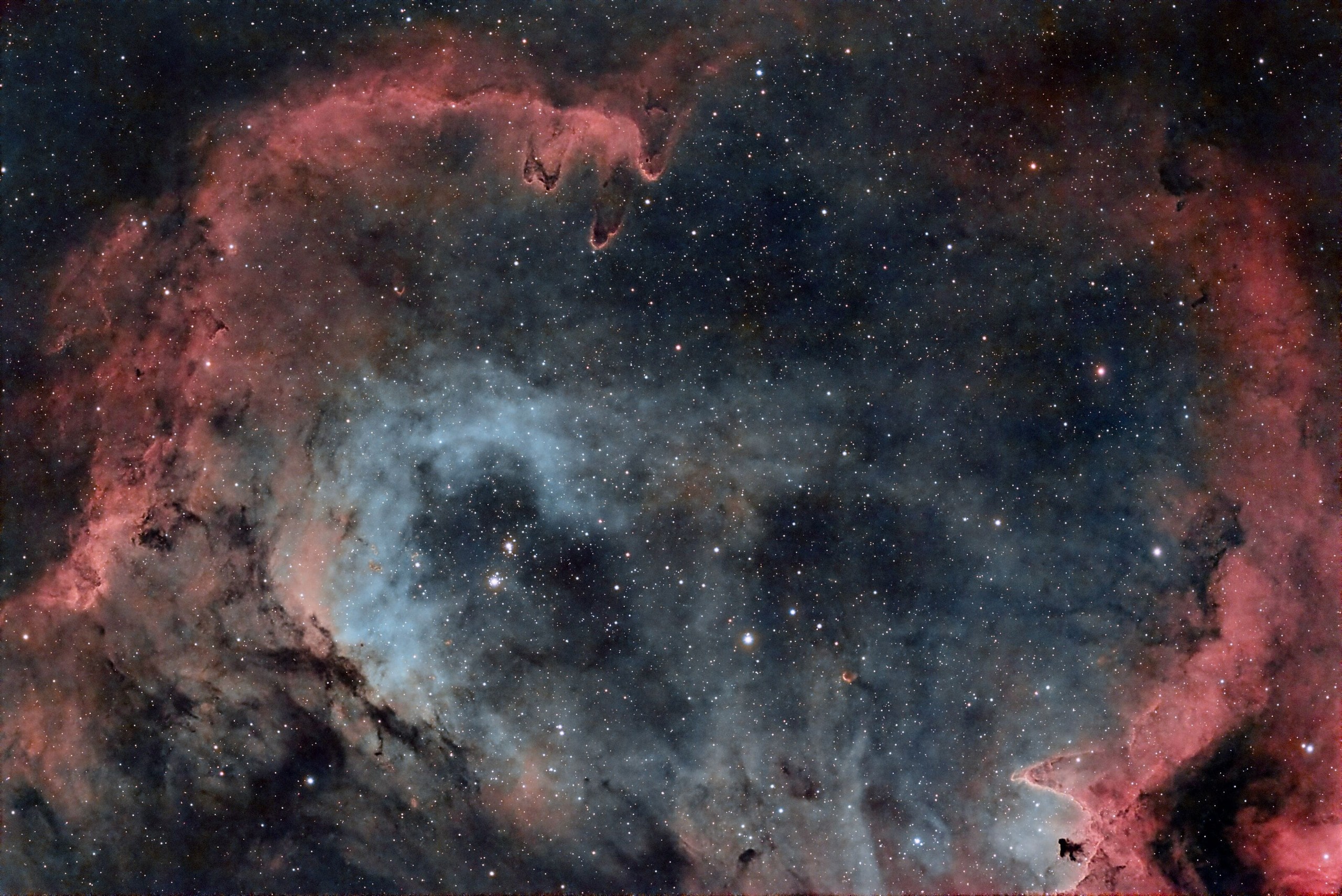
The Soul Nebula (IC 1848): A cosmic portrait of star birth
In the constellation Cassiopeia, about 6,500 light-years from Earth, lies a beautiful and mysterious nebula known as IC 1848, or — more poetically — the Soul Nebula. Together with its neighbour, the Heart Nebula (IC 1805), it forms an iconic pair in the sky. Although the name sounds romantic, the nebula has nothing to do with souls: it owes its nickname to a shape that — with some imagination — resembles a head and torso in profile, like a human face at rest.
Discovery and early observations
The nebula was first recorded in the early 20th century as part of the Index Catalogue (IC), an extension of the New General Catalogue (NGC) of celestial objects. At the time, astronomers using optical telescopes mainly saw a faint, diffuse cloud — a so-called “nebula” — without yet knowing exactly what such a cloud consisted of or how far away it was.
Only later, with the arrival of spectroscopy and modern astrophotography, were scientists able to determine that IC 1848 is not a galaxy but an emission nebula: a gigantic cloud of ionised hydrogen gas, illuminated by young, hot stars that were born within it.
What are we looking at?
The Soul Nebula is essentially a stellar nursery. New stars are continually forming inside this cloud, which spans more than 100 light-years. Those young stars emit intense ultraviolet radiation that makes the surrounding gas glow — producing the bright red seen in many photographs. Dark lanes in the nebula are dense clouds of dust that block the light. In some of those dust clouds, new stars are forming even now.
What have we learned?
By studying the Soul Nebula, astronomers have learned a great deal about how stars and stellar environments evolve. Thanks to modern telescopes — from space observatories such as Spitzer and Hubble to ground-based radio telescopes — we now know that star formation is not a calm process. Powerful stellar winds, colliding gas clouds and radiation pressure create a chaotic environment, yet new stars repeatedly emerge from that chaos.
A view into both the past and the future
Because the light from the Soul Nebula takes about 6,500 years to reach us, we are effectively looking back in time — to an era when the first cities on Earth were only beginning to emerge. Yet what we see remains relevant: the processes within the Soul Nebula unfold over such enormous timescales that they continue today in much the same way.