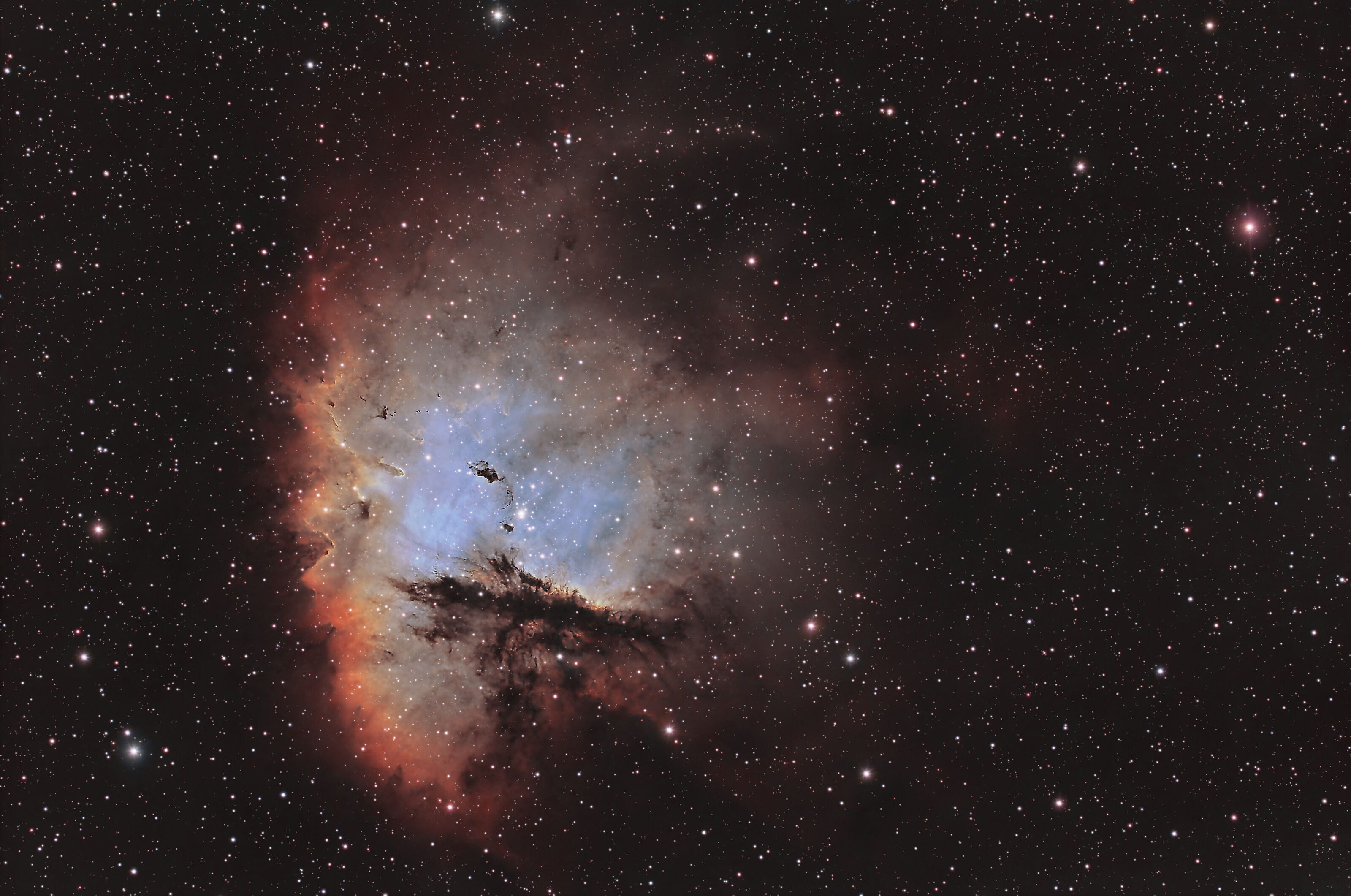
NGC 281 is better known as the Pacman Nebula, and once you see its shape, the nickname makes perfect sense. In wide-field images, a dark lane of dust cuts into the glowing cloud, making it look like the famous arcade character taking a bite out of space.
The nebula lies in the constellation Cassiopeia, about 9,200 light-years away. It is an emission nebula, which means the gas is not just reflecting light: it is actually glowing. Young, massive stars inside the nebula give off powerful ultraviolet radiation. This radiation energizes the surrounding hydrogen gas, causing it to shine.
At the heart of the Pacman Nebula is the young star cluster IC 1590. These stars are only a few million years old, which is very young in cosmic terms. Some of them are massive, hot stars that act like engines for the entire nebula. Their radiation and stellar winds carve, heat, and shape the surrounding gas and dust.
One of the most interesting features in NGC 281 is the presence of dark Bok globules: small, dense clouds of dust and gas silhouetted against the brighter nebula behind them. These dark knots may look like empty holes, but they are actually rich pockets of material. In some cases, places like these can become future birthplaces of stars.
So when you look at the Pacman Nebula, you are not just seeing a funny shape in the sky. You are looking at a real stellar nursery: a place where young stars light up their surroundings, where dark dust clouds hide new possibilities, and where the next generation of stars may already be forming.