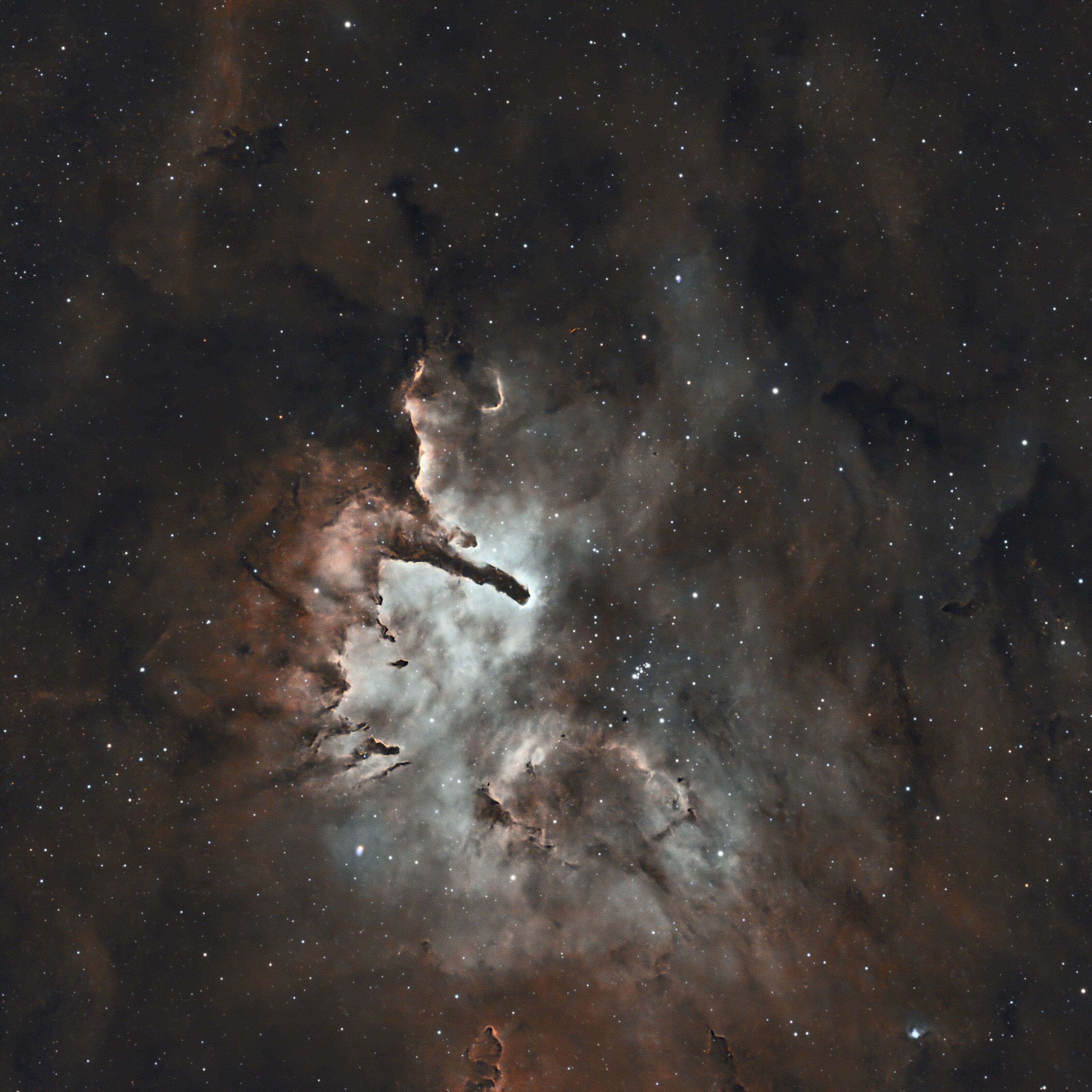
At first glance, the scene looks like a cosmic painting: bright clouds of gas lit from within, dark tendrils stretching like smoke across space, and a dense cluster of young stars blazing at the center. This is NGC 6823, a vibrant star-forming region located in the faint constellation Vulpecula, the Little Fox.
The central star cluster, NGC 6823 proper, was born only about 2 million years ago — an eye-blink in cosmic terms. The surrounding glowing gas and dark dust lanes form a larger emission nebula (part of Sharpless 2-86) that is still busy creating stars today. The energy and radiation from the newborn stars carve away at the surrounding molecular clouds, creating the sharp ridges, pillars, and cavities you see in this image. These dark fingers of dust, silhouetted against the glowing gas, are sometimes called elephant trunks: they are dense regions where new stars may still be gestating, hidden from our view.
The Meaning of the Colors
This image uses a narrowband technique to isolate specific wavelengths of light emitted by excited gases:
Red/orange tones represent sulfur (SII) emissions.
Greenish hues trace hydrogen-alpha (Hα), the most abundant element in the nebula.
Bluish tones highlight oxygen (OIII).
Together, these colors don’t show the nebula as our eyes would see it, but they reveal the chemical fingerprints of the cosmos. Each hue corresponds to an element being energized by ultraviolet light from young, massive stars — glowing like neon signs in interstellar space.
What’s Happening Here?
NGC 6823 is a stellar nursery:
Gas collapses under gravity, igniting nuclear fusion in newborn stars.
Radiation pressure from these stars sculpts and erodes the surrounding clouds.
Shockwaves from earlier generations of stars may have triggered this new burst of formation, passing the torch of creation forward.
It’s a vivid example of how the galaxy constantly recycles itself — stars form from gas, shine brightly, and eventually return material to space for the cycle to begin again.
Why It Matters
Looking at NGC 6823 is like catching the universe in the act of creation. The very atoms in our bodies — carbon, oxygen, nitrogen — were forged in earlier generations of stars like those forming here. In a sense, this image isn’t just a picture of deep space: it’s a snapshot of our own origins, written in light across the night sky.