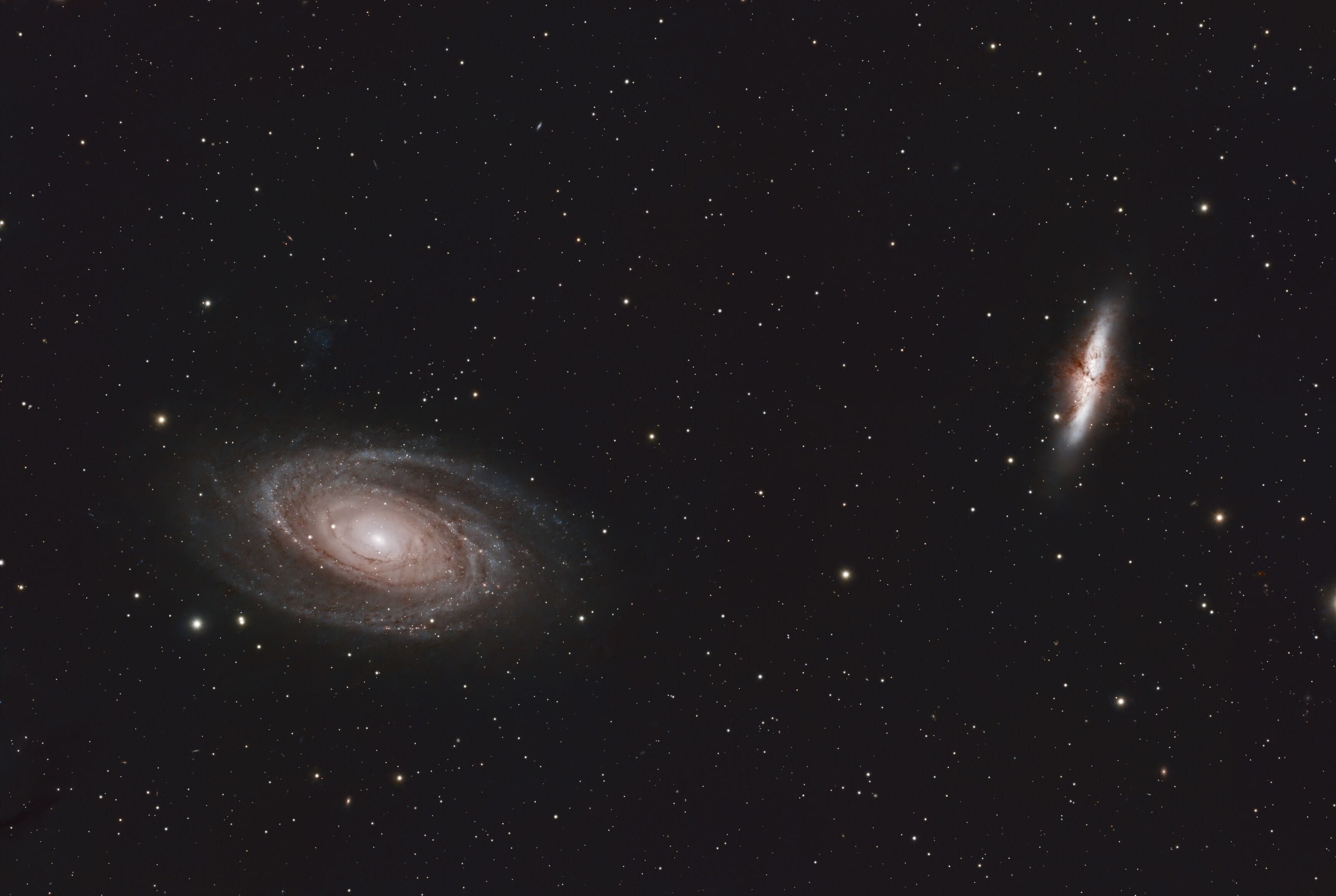
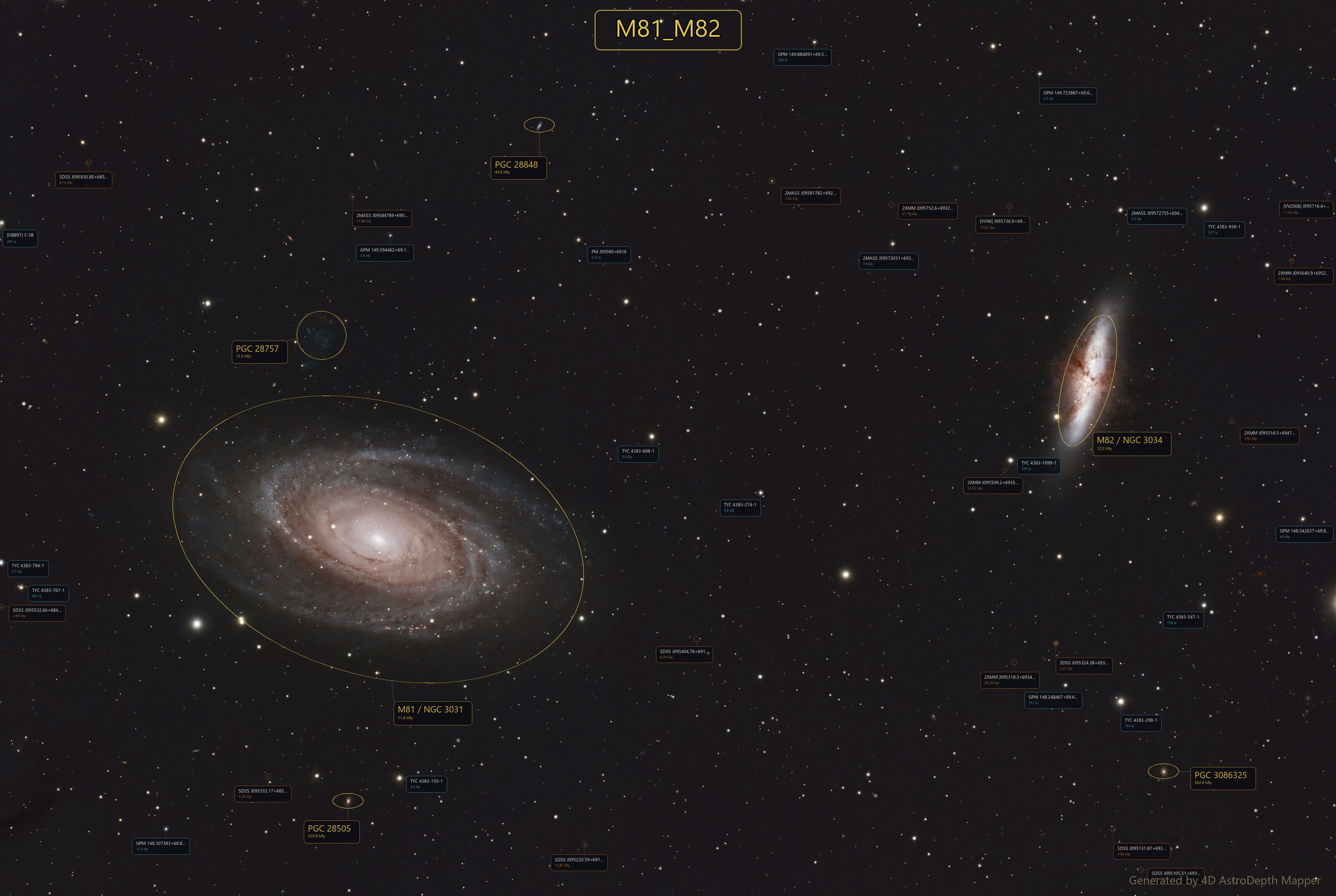
This image shows two of the most famous galaxies in the northern sky: M81 on the left and M82 on the right. They lie in the constellation Ursa Major, about 12 million light-years away. That makes them far beyond our own Local Group, but still close enough to be considered part of our nearby cosmic neighbourhood.
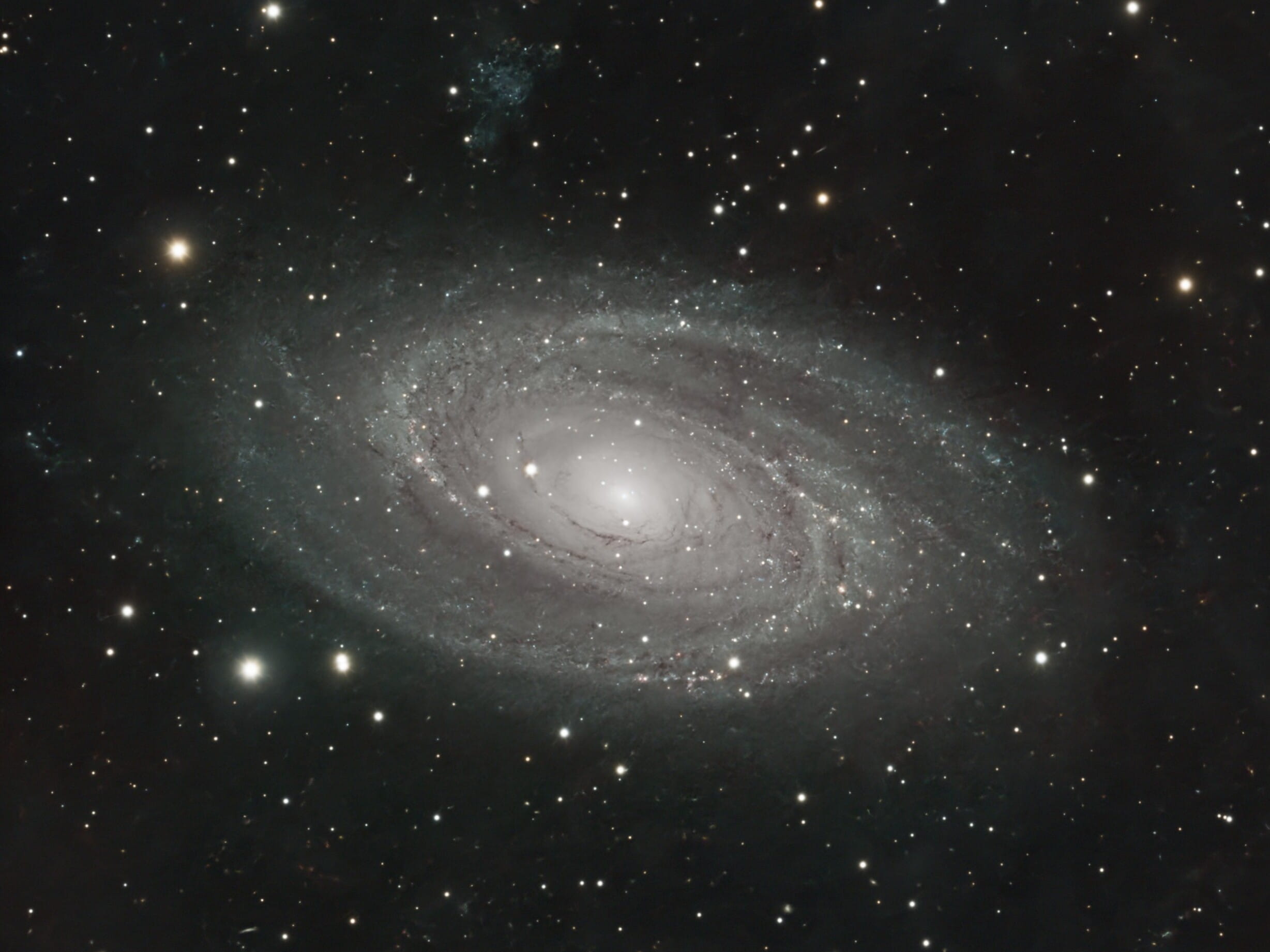
M81, also known as Bode’s Galaxy, is the large spiral galaxy on the left. Its bright central core and graceful spiral arms make it look calm and well-ordered. In reality, it has been shaped by gravity just like its more chaotic-looking neighbour.
M82, the Cigar Galaxy, looks very different. It is seen almost edge-on and appears crossed by dark dust lanes and reddish glowing regions. These red structures are clouds of hydrogen gas, lit up by intense star formation. M82 is a starburst galaxy: it is producing new stars at a much higher rate than a normal spiral galaxy.
The reason for this activity is interaction. Millions of years ago, M81 and M82 passed close enough to strongly disturb each other through gravity. M81’s spiral structure was affected, while gas inside M82 was compressed and driven toward its centre. That triggered a powerful burst of star formation, and energetic winds now blow gas and dust outward from M82’s core.
The two galaxies are not alone. They belong to the M81 Group, one of the nearest galaxy groups outside our Local Group. This group contains several other galaxies and faint tidal structures, some of which were created by past gravitational encounters. In deep images, the surrounding sky also shows very faint dust and background galaxies, reminding us that one photograph can contain many layers of cosmic distance.
What we see here is therefore more than a beautiful pair of galaxies. It is a snapshot of galactic evolution: one large spiral galaxy, one disturbed starburst galaxy, and the invisible force of gravity shaping both across millions of years.