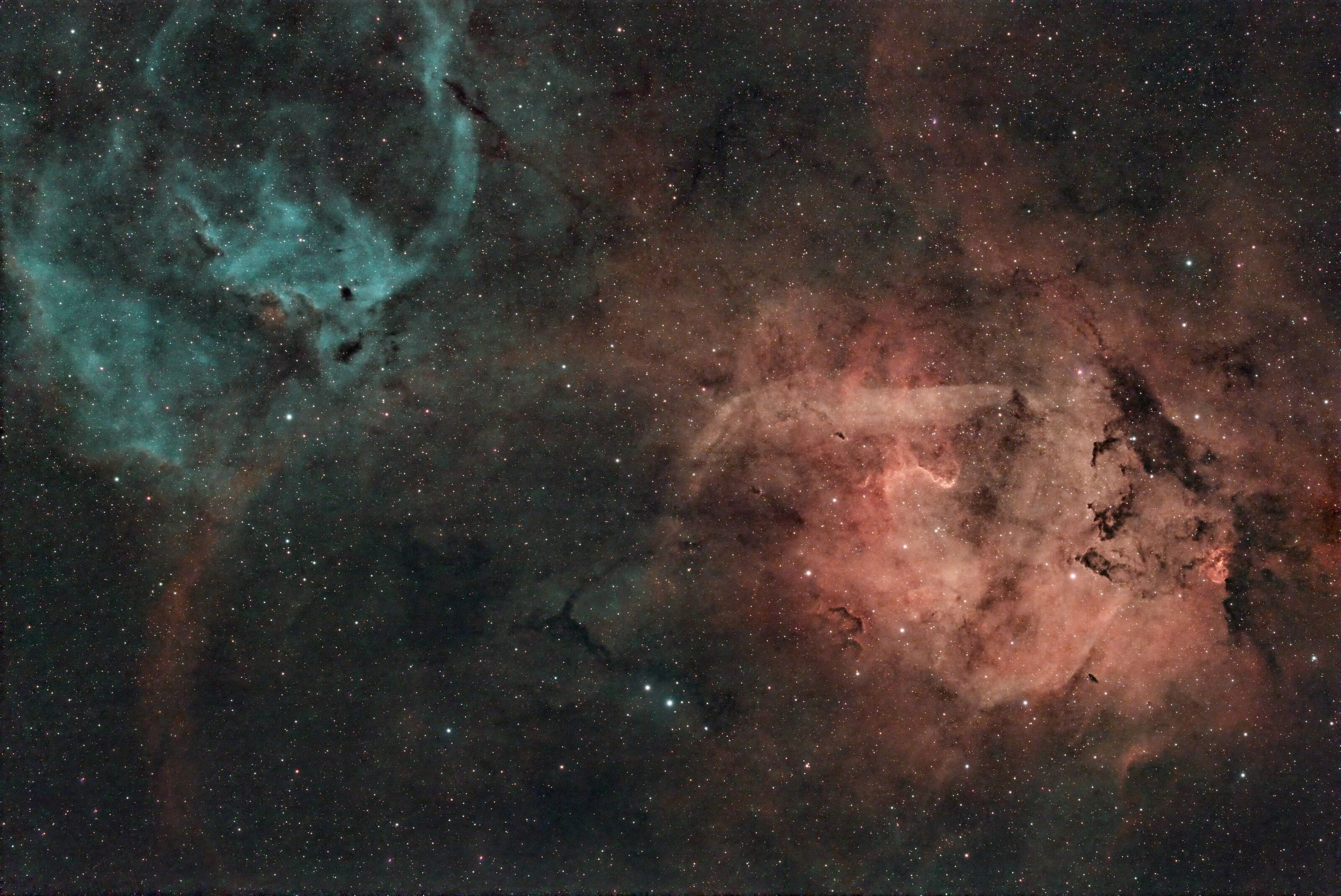
Sharpless 2-132, also known as the Lion Nebula, is a large cloud of glowing gas in the constellation Cepheus, close to the border with Lacerta. It lies about 10,000 light-years from Earth, in the Perseus Arm of our Milky Way galaxy.
The name “Lion Nebula” does not mean that it is located in the constellation Leo. Instead, the name comes from its shape. In some astrophotos, the nebula looks a little like the head of a lion, with flowing clouds of gas that resemble a mane.
Sh 2-132 is an emission nebula. This means that the gas is not simply reflecting light, but is actually glowing. Very hot, massive stars inside and near the nebula send out powerful ultraviolet radiation. This radiation energizes the surrounding hydrogen gas, making it shine.
The nebula is a good example of an H II region: a region of ionized hydrogen around young, hot stars. These places are important in astronomy because they are linked to the birth and early life of stars. Over time, radiation and stellar winds from massive stars push, heat, and shape the surrounding gas and dust.
In this image, you can see a complex mixture of glowing gas, dark dust, and curved structures. The red colour mainly comes from hydrogen gas, especially H-alpha emission. Blue-green areas are often linked to oxygen emission, especially O III, which appears in hotter or more energetic parts of the nebula. These colours are typical in narrowband astrophotography, where special filters are used to capture specific types of light from hydrogen, oxygen, and sulphur.
The darker lanes and patches are clouds of dust. They block light from the glowing gas behind them, creating strong contrast and giving the nebula much of its dramatic structure. Some of these dense regions may be connected with future star formation.
You may also notice arcs and bright edges in the nebula. These are places where radiation and stellar winds from massive stars are interacting with the surrounding gas. They can be thought of as “front lines” where young stars are shaping the cloud around them.
Sh 2-132 is faint and difficult to see visually through a telescope. Long exposure times and narrowband filters are usually needed to bring out its delicate structures. That makes it a challenging target, but also a very rewarding one for astrophotography.
When you look at this image, you are seeing a huge stellar nursery: a region where massive stars, glowing hydrogen, oxygen-rich gas, and dark dust all interact. It is a snapshot of the ongoing cycle of matter in our galaxy, where gas clouds can give birth to stars, and stars in turn reshape the clouds around them.