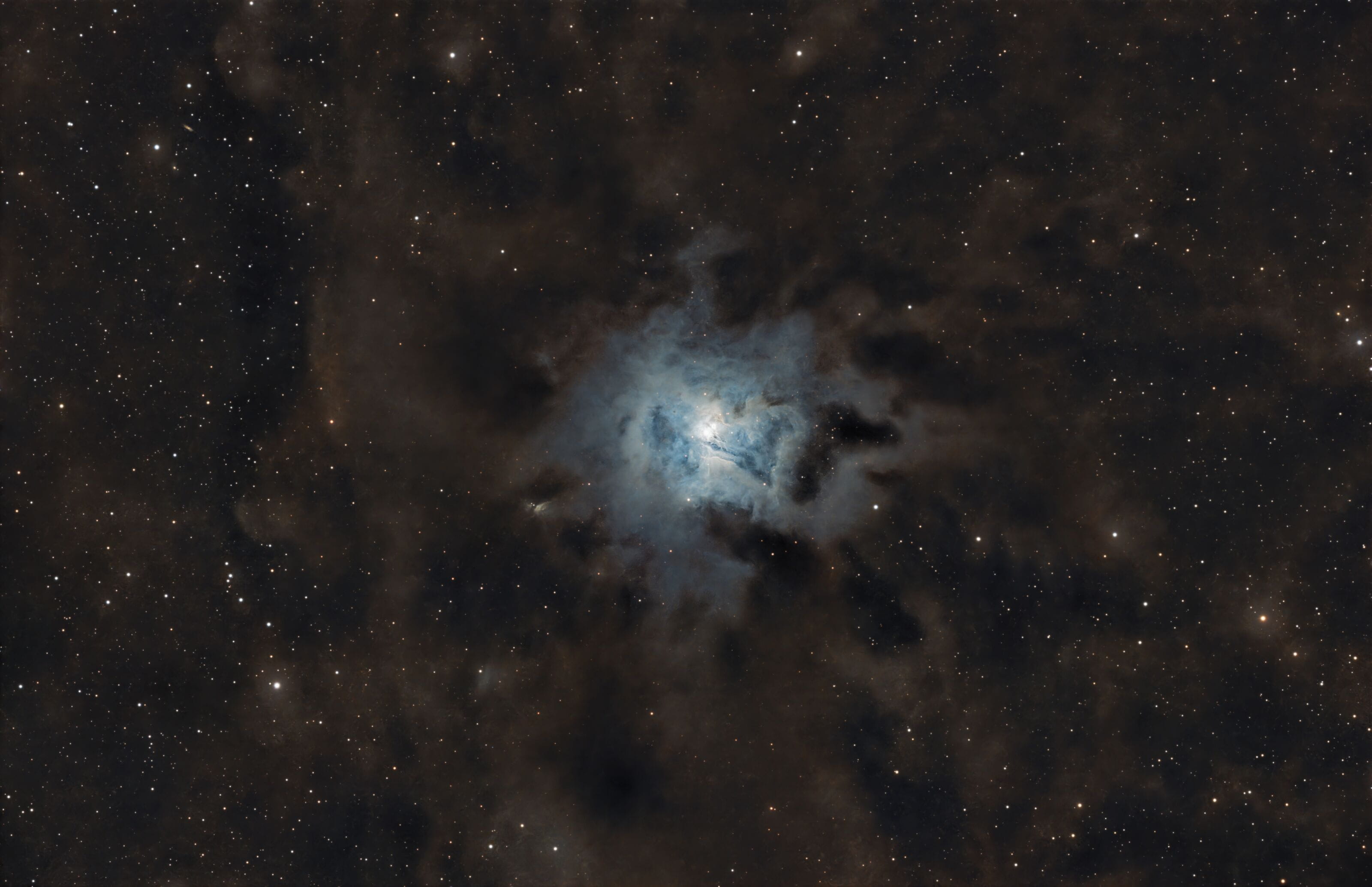
The Iris Nebula, also known as NGC 7023 or Caldwell 4, is a cloud of gas and dust in the constellation Cepheus. It lies about 1,300 light-years from Earth and is roughly six light-years across.
What makes the Iris Nebula special is that it is a reflection nebula. This means it does not shine strongly by itself. Instead, its dust reflects the light of a young, hot star near its centre, called HD 200775. The blue colour is caused by starlight scattering from tiny dust particles, in a similar way to how Earth’s atmosphere scatters sunlight and makes our daytime sky appear blue.
The dark areas in and around the nebula are thick clouds of cold dust and gas. These clouds block some of the light behind them, creating the dramatic shapes and contrast visible in the image. Some regions also show reddish tones, caused by complex molecules in the dust reacting to energetic light from the central star.
The Iris Nebula is not just beautiful; it is also scientifically interesting. Astronomers study it to better understand cosmic dust, the chemistry of space, and how stars can shape the clouds around them. Hidden inside parts of the nebula are young stellar objects, showing that this region is connected with the birth and early life of stars.
When you look at this image, you are seeing a vast dusty cloud illuminated from within: a quiet stellar nursery, sculpted by light, radiation, dust, and gravity.